I’m a big fan of Alfie Kohn. He’s deeply humane, unafraid to disagree with commonly accepted ideas, always on the side of students, tireless in his advocacy on their behalf—and he grounds his opinions in research. I often recommend his books—especially The Homework Myth and Punished by Rewards.
Recently, however, he posted a piece titled “How to Create Nonreaders: Reflections on Motivation, Learning, and Sharing Power” on his web site after its appearance in the Fall 2010 issue of English Journal, and concerning part of what he says in it, I must disagree.
First, a confession: I have for almost thirty years been giving students marks based on the number of pages they complete for Independent Reading. You can read about my Independent Reading program here. According to Kohn, this approach should have been discouraging and demotivating for my students, and if he is right then I have spent three decades turning students into non-readers. But I know that this is not the case. Instead, I have spent thirty years helping non-readers and reluctant readers and second-language learners discover the joys of reading and improve their skills. I have seen the pride in their faces when they have reflected on how many books they have read at the end of the school year—more, often, than ever before; more, sometimes, than in their whole lives up until then. And year after year I have had comments like these from my students as they look back on their year of reading (these are unedited, but I have put portions in bold-face type):
Sam
At the very start of the year, the first day actually, Mr. Macknight already assigned us a daily homework, the homework was reading every day fifteen minutes. For the first couple of weeks, I didn’t really take it seriously and I must admit, I barely ready anything. But when our first report cards came out, I realized that my grade could have been better if I only read more, so decided to read much more. At first, I struggled a little bit, since it was a bit hard from reading almost nothing to about a bit more than a hundred pages a week. Something else that made it harder for me is my laptop, since I always wanted to go and do something else, but by reading every day, I also started reading different types of books, different styles, like thrillers, action, puzzle, etc. Reading so many different types of books taught me to like different authors, not one I always read like ‘Anthony Horowitz’, but not only did the independent reading help with that, it also made me learn a huge amount of new vocabulary. This will help me be ahead of people of my own grade in Belgium!!
Jia Xin
I wasn’t in Mr. Macknight class in September and we did not have independent reading or blogs. I did not read much until I came to English A.
At first, I read a lot because I knew that the independent reading could make a different in my report card grade. I am not a native English speaker but I want to maintain my grade so I read novel every night after I finished my homework. Now, I did not read as much as I first came to English A because there were more and more projects and less spare time. You might think that this is an excuse, I think so as well, I became lazy, kind of. I think that I read better in the morning because my mind is clearer during morning when I woke up. I always fall asleep at night when I read novel and I don’t think I remember the events that happened. Sometimes, night gave me the mood of the character in the story and I felt scare of reading it. I read in the morning, which means I have less time for reading because I have to rush to school everyday so I read less.
I changed from a person who wanted to get a good grade in report card so I read more books to a person wanted to dip into a friction that is full of imagination and adventures that I might not even see in my entire life or into a non-friction world that tells me what the real world looks like and how people survive in it. I read at lot in the beginning of this semester and I found out that I really like non-friction stories because I wanted to see the real world outside and how people manage to live in this “world” that we are going to join soon and after. I know I shouldn’t have just read one kind of genre (what I meant for genre is friction or non-friction) but I would try to read other genre that interests me. How did I change? I don’t know the answer. I just know that I read more and found out what I like and just go for it.
I knew that I learned a lot when I read books. I learned new vocabularies, grammars used, culture of the certain country, life of other in real world, etc. I also know what genre or type of books do I like the most, which means I get to know myself better.
Yi Su
Was I ever a good reader? I never was. If I was not in Mr.Macknight’s class and had to write independent journal, I wouldn’t have read a lot. Since my first language is Korean, not English, and even though I’m in Language A, it is hard for me to read books in English. Moreover, expression is different in English. That is why sometimes I don’t get jokes from books. Every time I don’t get what they character is saying, I asked my English speaking friends. As I learn many new stuffs from books, I began to read more and more (Some books, I didn’t write Ind. Reading journals).
Li Fan
Back in 2009 September, I did not really read much book at that time. In fact reading was on my top dislike list, but now reading became one of my habits everyday. This change started from the day I entered Mr. Macknight’s classroom once again after grade 7. The course was still similar to the one before, but this time I learned a lot more from the books I read. Some of the most important reading experiences I gained this year will be to actually enjoy in reading. At first I was forced to read, as a 28 pages or more is needed to achieve a good grade, but as time goes on I started to pay a much closer attention to every vocabulary, every word, every sentence I read. Actually, what is most important to me will be to enjoy reading. Once you are in with the plot line, everything will go together naturally. For this summer, I am planning to read better quality books, as what I need now is to focus more on my use of language and grammar.
Yoo Min
Since English is not my mother tongue, and I am not that kind of person who loves challenging, I hated most of the things that related to English. When I first came to SSIS and read an english book, I almost cried, I thought I was too stupid. I took almost a month to read a book, even though my English skill became better, I still hated reading. I think I would not read even one book for this year if Mr. Macknight did not require us to read. However at the beginning of the year Mr. Macknight told us a good method which is “read what you want to read”. Even though it was pain in the neck to look for new vocabulary, I wanted to because I was curious to know next issue. And this make me spend more time on reading than before. Anyway from now I need to start reading more kinds of deep meaning book rather than entertaining books.
So now, since I usually agree with Alfie Kohn, I have to try to explain why his theory predicts results that I only rarely see in my practice.
In the opening of his English Journal article, Kohn writes, “ . . . it is impossible to motivate students”. But I don’t think of myself as motivating my students to read by giving them grades for it. I don’t even think of myself as rewarding them with grades. Instead, it seems to me that receiving grades for work done is, in the context of a school, simple fairness and justice. Grades, after all, are the currency of schools. Can I imagine a better, more humane way to offer education to young people? Absolutely. But in the meantime, we have the schools we have. And in those schools, students receive grades and credits and diplomas in return for the work they do. It’s a fairly straightforward transaction. Think of it this way: how should a student feel if she is told to do an assignment in school and then informed that she will receive no grades or credit for her work?
But the grades aren’t motivation. And I don’t try to motivate my students at all, really: I try to inspire them. I try to make them believe in themselves and the limitless possibilities of their futures, and I try to show them that if they become readers they will open up doors for themselves. And once they start reading, with the right guidance and help, they begin to discover the joys of reading, and after that my work is easy.
In other words, I see myself doing exactly what Kohn describes in this paragraph:
What a teacher can do – all a teacher can do – is work with students to create a classroom culture, a climate, a curriculum that will nourish and sustain the fundamental inclinations that everyone starts out with: to make sense of oneself and the world, to become increasingly competent at tasks that are regarded as consequential, to connect with (and express oneself to) other people. Motivation – at least intrinsic motivation — is something to be supported, or if necessary revived. It’s not something we can instill in students by acting on them in a certain way. You can tap their motivation, in other words, but you can’t “motivate them.” And if you think this distinction is merely semantic, then I’m afraid we disagree.
A bit further on, however, this is how Kohn describes what I do:
Nothing contributes to a student’s interest in (and proficiency at) reading more than the opportunity to read books that he or she has chosen. But it’s easy to undermine the benefits of free reading. All you need to do is stipulate that students must read a certain number of pages, or for a certain number of minutes, each evening. When they’re told how much to read, they tend to just “turn the pages” and “read to an assigned page number and stop,” says Christopher Ward Ellsasser, a California high school teacher.[2] And when they’re told how long to read – a practice more common with teachers of younger students — the results are not much better. As Julie King, a parent, reports, “Our children are now expected to read 20 minutes a night, and record such on their homework sheet. What parents are discovering (surprise) is that those kids who used to sit down and read for pleasure — the kids who would get lost in a book and have to be told to put it down to eat/play/whatever — are now setting the timer…and stopping when the timer dings. . . . Reading has become a chore, like brushing your teeth.”
A very small minority—one to three students per year—have responded to my Independent Reading program in that way. In such cases, I am ready to throw out the system and do whatever works. But in my classes, a very large majority of students are not “those kids who used to sit down and read for pleasure — the kids who would get lost in a book and have to be told to put it down to eat/play/whatever”, and most often the simple act of crediting them for their work is enough to get them started reading.
If I found myself teaching a group of students whose inspiration to read was deflated by giving them grades for it, would I change my methods? Of course! But until then I will have to respectfully disagree with Mr. Kohn on this one point.

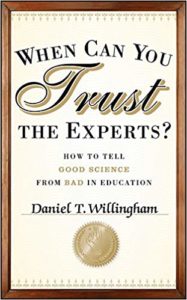 Only this year I have I discovered his subsequent work, When Can You Trust the Experts? (Jossey-Bass, 2012), and I am kicking myself for not reading it sooner. It would have been an outstanding book to use with students when I was teaching IB Theory of Knowledge, which poses the questions, “What do we know, and how do we know it? What do we believe, and why do we believe it?” Willingham addresses those questions in a practical way that would be especially valuable in a TOK class because educational psychology is a social science, and the social sciences deal with complex, messy human situations that make experiments, measurement, evidence, and conclusions problematic—but not always impossible.